

Get Real 1z0-1054-25 Quesions Pass Oracle Certification Exams Easily
1z0-1054-25 Dumps are Available for Instant Access
NEW QUESTION # 14
For translation purposes, the Financials reporting team has decided to load the monthly Historical currency rates by using File-Based Data Interface (FBDI).
What happens to the existing historical rate for a specific ledger, currency, account combination, and accounting period if they use insert in the spreadsheet?
- A. The historical rate is replaced.
- B. Nothing, existing historical rates are not updated.
- C. Historical rates are converted into an average rate (original and new rate).
- D. The existing historical rate is deleted.
Answer: A
Explanation:
If you use insert in the spreadsheet to load the monthly historical rates by using FBDI, the existing historical rate for a specific ledger, currency, account combination, and accounting period will be replaced by the new rate. This is because the insert action will overwrite the existing rate with the new rate in the GL_HISTORICAL_RATES_INT table. If you want to preserve the existing rate, you should use update or delete actions instead. References:
* How Historical Rates Import Data Is Processed, Section: Use the Historical Rates Import file-based data import (FBDI) template to import historical rates from external and legacy sources to Oracle General Ledger
* Import Historical Rates, Section: Details
* Entering Historical Rates, Section: Entering Historical Rates
NEW QUESTION # 15
In the implementation project, there is a requirement to add new transactional attributes to the journal approval notification.
Which two Business Intelligence catalog objects should you copy (or customize) and edit? (Choose two.)
- A. The Data Model
- B. Output type
- C. The Sub Template
- D. The layout Template
- E. The Style Template
Answer: A,B
Explanation:
To add a global branding logo and more predefined transactional attributes to the journal approval email notification, you should copy (or customize) and edit the layout template and the data model. The layout template is a file that defines the appearance and content of the notification, such as text, images, tables, or charts. The data model is a file that defines the data sources and queries that provide data for the notification, such as predefined transactional attributes. You can copy (or customize) and edit the layout template and the data model using Oracle Analytics Publisher reports. You do not need to copy (or customize) and edit the output type, as this is a setting that determines the format of the notification output, such as HTML or PDF.
You do not need to copy (or customize) and edit the style template, as this is a file that defines the styles and formatting of the notification elements, such as fonts, colors, or margins. You do not need to copy (or customize) and edit the sub template, as this is a file that contains reusable content or logic that can be referenced by multiple layout templates. Reference: Oracle Financials Cloud: General Ledger 2022 Implementation Professional Objectives - Configure Workflow Approvals and Notifications 12
NEW QUESTION # 16
A new Oracle Fusion Cloud client needs to produce an income statement on a regular basis using Smart View.
Which Smart View tool would be best for this?
- A. Account Groups
- B. Smart Queries
- C. Smart Slices
- D. Query Designer
Answer: D
Explanation:
Query Designer is a Smart View tool that enables you to create and modify ad hoc queries on General Ledger balances cubes. You can use Query Designer to select the dimensions, members, and filters that you want to include in your query, and then retrieve the data in a grid format in Excel. You can also save, open, and refresh your queries as needed. Query Designer is the best tool for producing an income statement on a regular basis using Smart View, because it allows you to easily access and analyze the income and expense accounts, as well as the ledger, period, currency, and other dimensions that are relevant for your report. You can also customize the layout and format of your grid, and use Excel functions and features to enhance your report. References:
* Overview of Smart View
* Creating an Ad Hoc Analysis in Smart View
NEW QUESTION # 17
You are creating a Multitier Intercompany agreement and haven chosen to use a clearing organization in Financial Route.
How many clearing organizations can be involved in Financial Route?
- A. 0
- B. 1
- C. 2
- D. 3
Answer: B
NEW QUESTION # 18
Your company wants to change theCumulative Translation Adjustment (CTA) accountto record gains/losses from varying currency rates.
What steps must you perform to achieve this objective without causing data corruption?
- A. Open the Ledgers page and update the CTA account and then rerun Translation for all periods required.The system will automatically update the translated balances.
- B. Define a new ledger and accounting configuration. The CTA account cannot be updated after the ledger has been in use.
- C. Purge all translated balances, change the CTA account in the Ledger page, and rerun Translation for all periods required.
- D. Query the Translation journals and delete all of them, then change the CTA account in the Ledger page, and rerun Translation for all periods required.
Answer: C
NEW QUESTION # 19
You are planning to create an Income Statement using Smart View.
Which Smart View tool should you use for this?
- A. Query Designer
- B. Smart Queries
- C. Smart Slices
- D. Ad Hoc Analysis
Answer: D
Explanation:
To create an Income Statement using Smart View, you should use Ad Hoc Analysis. Ad Hoc Analysis is a Smart View tool that allows users to view and analyze financial data from General Ledger Cloud using Essbase cubes. Users can create reports such as Income Statements or Balance Sheets by selecting dimensions and members from Essbase cubes and retrieving data into Excel worksheets. Users can also perform actions such as drilling down, pivoting, zooming in or out, or expanding or collapsing members
NEW QUESTION # 20
You are required to changetoday's daily ratesfor convertingGBP to USD. What are three ways in which you can update existing daily rates?
- A. Edit existing transactions and update the rates manually.
- B. Use the spreadsheet loader from the Currency Rates Manager.
- C. Update rates manually using the Currency Rates Manager, which can be accessed from the Functional Setup Manager or the General Ledger's Period Close work area.
- D. Update rates manually using the Currency Rates Manager, which can be accessed only from the Functional Setup Manager.
- E. Import daily rates through the Daily Rates open interface table.
Answer: B,C,E
NEW QUESTION # 21
You have enabled budgetary control and have a control budget set toAdvisorycontrol level. For September
2016, your budget for a given account combination is$5,000 USD.
In the same month, there is anapproved requisitionfor that account of$900and anapproved purchase order for that account of$2,500 USD. There is also aGeneral Ledger adjustment journal entryfor that account of
$1,600 USD. Anapproved purchase order line of $400 USDis thencanceled.
Aninvoice is matchedto the purchase order for$2,100 USD.
Which two statements are true? (Choose two.)
- A. The system always consumes the budget of future periods if the limit for the current period is expired, so October 2016 budget will be considered for reservation.
- B. As there are cancellations for $400 USD, the system will partially reserve the funds in September 2016 and fully reserve it in October 2016.
- C. Funds reservation only happens for non-matched invoices, so the system will not reserve funds.
- D. Purchase order encumbrance will be released for $2,100 USD.
Answer: B,D
NEW QUESTION # 22
Which three factors should you consider while specifying Intercompany System options?
- A. Whether to enforce an enterprise-wide currency or allow intercompany transactions in local currencies
- B. Whether to allow receivers to reject intercompany transactions
- C. Automatic or manual batch numbering and the minimum transaction amount
- D. Automatic or manual batch numbering and the maximum transaction amount
- E. Approvers who will approve intercompany transactions
Answer: A,B,C
Explanation:
Intercompany System options are used to set up intercompany processing rules at the enterprise level, based on your specific business needs. They help you standardize and simplify transaction processing, minimize disputes, and reduce administrative costs. The three factors that you should consider while specifying Intercompany System options are:
* Automatic or manual batch numbering and the minimum transaction amount: These options help you control the numbering and the size of intercompany transactions. You can choose to use system generated or manual batch numbering, and you can specify a minimum threshold amount for intercompany transactions to prevent immaterial transactions. To use the minimum transaction amount option, you must also select an Intercompany currency option.
* Whether to enforce an enterprise-wide currency or allow intercompany transactions in local currencies:
This option helps you manage the currency risk and the conversion rate fluctuations for intercompany transactions. You can choose to standardize transaction processing by selecting an Intercompany currency, which means that all intercompany transactions created in the Intercompany module are entered in this currency. Alternatively, you can choose to allow intercompany transactions in local currencies, which means that intercompany transactions can be entered in the ledger currency of the sender or the receiver.
* Whether to allow receivers to reject intercompany transactions: This option helps you handle the approval and dispute resolution process for intercompany transactions. You can choose to allow receivers to reject intercompany transactions if they disagree with the sender's information, such as the amount, the account, or the date. If you enable this option, you must also specify the rejection reason and the notification details for the sender.
Intercompany System Options
Implementing Enterprise Structures and General Ledger
Implement General Ledger
NEW QUESTION # 23
You want to create an Ad Hoc Analysis in Smart View; you enter the following dimensions for the report and click Refresh in the POV.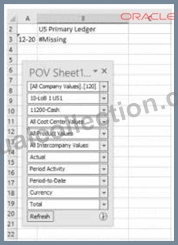
You get #Missing instead of a balance. What value did you not specify, which resulted in this?
- A. Product
- B. Cost Center
- C. Intercompany
- D. A particular currency
Answer: D
NEW QUESTION # 24
You attempt to activate a tree version, but the audit process fails. In which two ways can you resolve this?
- A. Run the Chart of Accounts Deployment process.
- B. Ensure that you do not assign children to child values.
- C. Run the Publish Chart of Accounts Dimension Members and Hierarchies program.
- D. Make sure all users sign out of the calculation manager.
- E. Ensure that parent values have the summary attributes set correctly.
Answer: B,E
NEW QUESTION # 25
Your new accountants have been making mistakes in reconciling accounts assigned to them. Your account balances have either spiked or dropped 30-40% every period due to human error. This causes delays in reconciliation.
Which feature can be used to proactively notify you of account anomalies in a more timely manner?
- A. Smart View
- B. Account Inspector and its charts
- C. Account Monitor
- D. Financial reports with embedded charts
Answer: C
NEW QUESTION # 26
When will Intercompany processing balance a journal using the accounts identified here for the UK Ledger?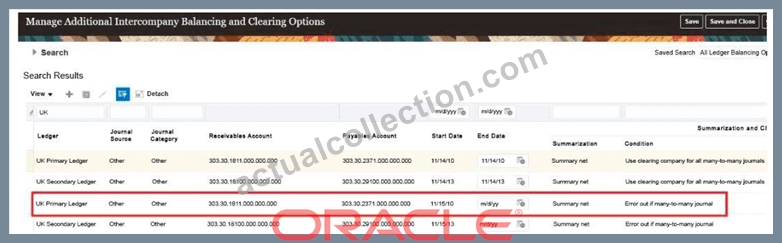
- A. when the journal is balanced by the primary BSV but not by second or third BSV
- B. when there is a many-to-many journal and you want to use a clearing company
- C. when the journal is balanced by second balancing segment value
- D. when the journal is not balanced by the primary balancing segment value (BSV)
Answer: A
Explanation:
Intercompany processing will balance a journal using the accounts identified here for the UK Ledger when the journal is balanced by the primary balancing segment value (BSV) but not by second or third BSV. A BSV is a segment in the chart of accounts that identifies a legal entity or business unit for which financial statements are prepared and balanced. A primary BSV is required for every ledger and is used to balance journal entries within a ledger. A secondary or tertiary BSV is optional and is used to balance journal entries across different dimensions other than the primary BSV, such as fund or region. Intercompany processing is a feature that enables intercompany transactions between different legal entities or business units within the same enterprise. Intercompany processing uses intercompany balancing rules to generate intercompany receivables and payables accounts for cross-ledger or cross-BSV journals. Intercompany processing will balance a journal using the accounts identified here for the UK Ledger when the journal is balanced by the primary BSV but not by second or third BSV, as this indicates that there is an intercompany transaction between different legal entities or business units within the UK Ledger that requires intercompany balancing.
Intercompany processing will not balance a journal using the accounts identified here for the UK Ledger when there is a many-to-many journal and you want to use a clearing company, as this is a scenario that involves multiple legal entities or business units across different ledgers that requires a separate clearing company ledger to perform intercompany balancing. Intercompany processing will not balance a journal using the accounts identified here for the UK Ledger when the journal is not balanced by the primary BSV, as this is an invalid scenario that violates the accounting rules and prevents posting of the journal. Intercompany processing will not balance a journal using the accounts identified here for the UK Ledger when the journal is balanced by second balancing segment value, as this is an incomplete scenario that does not specify whether the journal is also balanced by primary and third BSV. Reference: Oracle Financials Cloud: General Ledger
2022 Implementation Professional Objectives - Configure and Process Intercompany 12
NEW QUESTION # 27
You are using the Create Budgets in a Spreadsheet option to load your budget balances into the General Ledger balances cube. Your FYXX Budget is not appearing in the Budget Name list of values.
What are two reasons for this?
- A. A value for the budget scenario is not created.
- B. The Create Scenario Dimension Members program has not been run.
- C. Transfer Budget Balances to Budget Cubes has not been run.
- D. Publish Chart of Accounts Dimension Members and Hierarchies to the Balances Cube has not been run.
- E. Budgeting is not enabled in the Ledger options.
Answer: A,B
Explanation:
To use the Create Budgets in a Spreadsheet option, you need to have a budget scenario value and a scenario dimension member for your budget. A budget scenario value is a user-defined value that identifies a budget, such as FYXX Budget. A scenario dimension member is a member of the scenario dimension in the General Ledger balances cube that corresponds to a budget scenario value, such as FYXX_Budget. You can create budget scenario values and scenario dimension members using the Manage Budget Scenario Values task or the Create Scenario Dimension Members program. If you do not create these values and members, your budget will not appear in the Budget Name list of values in the spreadsheet. Therefore, the two reasons for your issue are:
* A value for the budget scenario is not created: You need to create a budget scenario value for your budget using the Manage Budget Scenario Values task. This task enables you to define and maintain budget scenario values and their attributes, such as description, start date, end date, and status. You can also specify whether the budget scenario value is enabled for budgeting and reporting. You need to enable the budget scenario value for budgeting to use it in the spreadsheet.
* The Create Scenario Dimension Members program has not been run: You need to run the Create Scenario Dimension Members program to create scenario dimension members for your budget scenario values. This program automatically creates scenario dimension members for all budget scenario values that are enabled for budgeting and do not have existing scenario dimension members. You can run this program manually or schedule it to run periodically. You need to run this program after you create or update budget scenario values to ensure that they are reflected in the scenario dimension.
Create Budgets in a Spreadsheet
Manage Budget Scenario Values
Create Scenario Dimension Members
NEW QUESTION # 28
You are using the Create Budgets in a Spreadsheet option to load your budget balances into the General Ledger balances cube. Your FYXX Budget is not appearing in the Budget Name list of values.
What are two reasons for this?
- A. A value for the budget scenario is not created.
- B. The Create Scenario Dimension Members program has not been run.
- C. Transfer Budget Balances to Budget Cubes has not been run.
- D. Publish Chart of Accounts Dimension Members and Hierarchies to the Balances Cube has not been run.
- E. Budgeting is not enabled in the Ledger options.
Answer: A,B
Explanation:
To use the Create Budgets in a Spreadsheet option, you need to have a budget scenario value and a scenario dimension member for your budget. A budget scenario value is a user-defined value that identifies a budget, such as FYXX Budget. A scenario dimension member is a member of the scenario dimension in the General Ledger balances cube that corresponds to a budget scenario value, such as FYXX_Budget. You can create budget scenario values and scenario dimension members using the Manage Budget Scenario Values task or the Create Scenario Dimension Members program. If you do not create these values and members, your budget will not appear in the Budget Name list of values in the spreadsheet. Therefore, the two reasons for your issue are:
* A value for the budget scenario is not created: You need to create a budget scenario value for your budget using the Manage Budget Scenario Values task. This task enables you to define and maintain budget scenario values and their attributes, such as description, start date, end date, and status. You can also specify whether the budget scenario value is enabled for budgeting and reporting. You need to enable the budget scenario value for budgeting to use it in the spreadsheet.
* The Create Scenario Dimension Members program has not been run: You need to run the Create Scenario Dimension Members program to create scenario dimension members for your budget scenario values. This program automatically creates scenario dimension members for all budget scenario values that are enabled for budgeting and do not have existing scenario dimension members. You can run this program manually or schedule it to run periodically. You need to run this program after you create or update budget scenario values to ensure that they are reflected in the scenario dimension.
Create Budgets in a Spreadsheet
Manage Budget Scenario Values
Create Scenario Dimension Members
NEW QUESTION # 29
You have created several account groups with the Display in option as Expenses.
Which setting determines the account group that will be displayed in the General Accounting infolets on your home page?
- A. Access is Shared
- B. Set as Default
- C. Access is Public
- D. Set in Expenses
Answer: B
NEW QUESTION # 30
A subsidiary company is about to configure their General Ledger in a highly regulated country where there is a legal requirement to produce fiscal reports under local GAAP. Subledgers transferring to General Ledger must use the local currency, and there is a requirement to report to the parent company (not local currency) using International Financial Reporting Standards (IFRS).
Which two ledger types should be configured to fulfill this reporting requirement?
- A. Reporting currency with the local accounting convention
- B. Primary ledger with the local accounting convention
- C. Reporting currency with the IFRS accounting convention
- D. Primary ledger with the IFRS accounting convention
- E. Secondary ledger with the IFRS accounting convention
Answer: B,E
Explanation:
A primary ledger is the main ledger for a legal entity or business unit that records all accounting transactions and maintains the accounting balances. A secondary ledger is an optional ledger that is associated with a primary ledger and maintains accounting balances in a different accounting representation. A reporting currency is an optional currency that is associated with a primary ledger and maintains accounting balances in a different currency. In this scenario, the subsidiary company needs to produce fiscal reports under local GAAP and local currency, as well as report to the parent company using IFRS and not local currency.
Therefore, the subsidiary company should configure a primary ledger with the local accounting convention and local currency, and a secondary ledger with the IFRS accounting convention and not local currency. A reporting currency with the local accounting convention or the IFRS accounting convention would not meet the requirement, as it would only maintain balances in a different currency, not a different accounting representation. A primary ledger with the IFRS accounting convention would not meet the requirement, as it would not comply with the local GAAP. References:
Oracle Financials Cloud Implementing Enterprise Structures and General Ledger, Chapter 2: Ledgers, Primary Ledgers, Secondary Ledgers, and Reporting Currencies Oracle Financials Cloud Using General Ledger, Chapter 1: Introduction, Ledgers and Subledgers, Primary Ledgers, Secondary Ledgers, and Reporting Currencies
NEW QUESTION # 31
Your ledger currency is USD. At month end you have a balance on the Accounts Payable Liability Account of
100,000 Euros which is equivalent to USD 136,550. This balance needs to be revalued.
The month end exchange rate for revaluation is 1 Euro = 1.3755 USD.
What two statements are true for the resulting revaluation run? (Choose two.)
- A. You have an unrealized exchange gain recorded.
- B. There is no unrealized exchange gain or loss calculated.
- C. The original journal entry in Euros is updated.
- D. The original journal entry in Euros remains the same.
- E. You have an unrealized exchange loss recorded.
Answer: A,E
Explanation:
The two true statements for the resulting revaluation run are that you have an unrealized exchange gain recorded and you have an unrealized exchange loss recorded. Revaluation is a process that adjusts foreign currency balances to reflect current exchange rates at period end. Revaluation creates journal entries to record unrealized exchange gains or losses on foreign currency balances based on revaluation rates defined for each currency. In this scenario, you have a balance on the Accounts Payable Liability Account of 100,000 Euros which is equivalent to USD 136,550 at month end. The month end exchange rate for revaluation is 1 Euro =
1.3755 USD. Therefore, after revaluation, your balance on the Accounts Payable Liability Account will be USD 137,550 (100,000 x 1.3755). This means you have an unrealized exchange gain of USD 1,000 (137,550
- 136,550) on your Accounts Payable Liability Account because your liability in foreign currency has decreased in terms of your ledger currency due to exchange rate fluctuations. Revaluation will create a journal entry to debit your Accounts Payable Liability Account by USD 1,000 and credit your Unrealized Exchange Gain Account by USD 1,000 to record this gain. The original journal entry in Euros is not updated by revaluation, as revaluation only creates new journal entries to adjust foreign currency balances in terms of ledger currency based on revaluation rates. There is no unrealized exchange gain or loss calculated by revaluation, as revaluation does calculate unrealized exchange gains or losses on foreign currency balances based on revaluation rates.
NEW QUESTION # 32
What are two uses of the Column Flattening and Row Flattening features? (Choose two.)
- A. Verify correctness of trees.
- B. Create additional versions of a tree.
- C. Set the status of a tree to active.
- D. View information for runtime performance.
- E. Optimize parent/child relationships.
Answer: A,C
Explanation:
The two uses of the Column Flattening and Row Flattening features are to set the status of a tree to active and to verify correctness of trees. Column Flattening and Row Flattening are features that optimize parent-child information for run-time performance by storing additional rows or columns in a table for instantly finding all descendants or ancestors of a node without initiating a recursive query. Column Flattening and Row Flattening are required to set the status of a tree to active, as they ensure that the tree data is consistent and accurate. Column Flattening and Row Flattening are also useful to verify correctness of trees, as they allow users to view and analyze the flattened hierarchy data using various tools such as Oracle Analytics Publisher or Oracle Transactional Business Intelligence. You do not use Column Flattening and Row Flattening to create additional versions of a tree, as this is a feature that allows users to copy an existing tree version and make changes to it without affecting the original version. You do not use Column Flattening and Row Flattening to view information for runtime performance, as this is a feature that allows users to monitor and measure the performance of various processes or tasks in Oracle Fusion Applications. You do not use Column Flattening and Row Flattening to optimize parent/child relationships, as this is a feature that allows users to define rules and constraints for how nodes can be related to each other in a tree structure. Reference: Oracle Financials Cloud: General Ledger 2022 Implementation Professional Objectives - Define Chart of Accounts 12
NEW QUESTION # 33
Your organization has implemented a global Chart of Accounts, which is used by all ledgers. It has the following segments: Company, Department, Account, Intercompany and Future.
Your business practice allows for one intercompany receivable natural account and one intercompany payable natural account.
What is the minimum level for configuring intercompany balancing rules?
- A. Legal Entity Rules
- B. Primary Segment Rules
- C. Ledger Rules
- D. Chart of Accounts Rules
Answer: D
NEW QUESTION # 34
The intercompany accountants on the cloud project are trying to reconcile intercompany balances using the latest intercompany reconciliation report.
However, they have some concerns about the information presented in the report and want you to clarify the content in the standard reconciliation report.
What is included in the intercompany reconciliation report?
- A. It displays all clearing company balances for the period.
- B. It displays ledger balancing lines generated when the primary balancing segment (BSV) is in balance but not the second or third BSVs.
- C. It displays the intercompany receivables and intercompany payables lines generated for the provider and receiver of each intercompany transaction.
Answer: C
NEW QUESTION # 35
......
Get Instant Access REAL 1z0-1054-25 DUMP Pass Your Exam Easily: https://exams4sure.actualcollection.com/1z0-1054-25-exam-questions.html