

Excellent SPLK-1003 Updated 2026 Dumps With 100% Exam Passing Guarantee
Best way to practice test for Splunk SPLK-1003
NEW QUESTION # 19
Which feature of Splunk's role configuration can be used to aggregate multiple roles intended for groups of users?
- A. Role federation
- B. Linked roles
- C. Grantable roles
- D. Role inheritance
Answer: D
Explanation:
You can have a role inherit certain properties from one or more existing role https://docs.splunk.com/Documentation/Splunk/8.0.5/Security/Aboutusersandroles
NEW QUESTION # 20
What is the correct curl to send multiple events through HTTP Event Collector?
- A. Option A
- B. Option D
- C. Option B
- D. Option C
Answer: C
Explanation:
curl "https://mysplunkserver.example.com:8088/services/collector" \ -H "Authorization: Splunk DF4S7ZE4-
3GS1-8SFS-E777-0284GG91PF67" \ -d '{"event": "Hello World"}, {"event": "Hola Mundo"}, {"event":
"Hallo Welt"}'. This is the correct curl command to send multiple events through HTTP Event Collector (HEC), which is a token-based API that allows you to send data to Splunk Enterprise from any application that can make an HTTP request. The command has the following components:
The URL of the HEC endpoint, which consists of the protocol (https), the hostname or IP address of the Splunk server (mysplunkserver.example.com), the port number (8088), and the service name (services
/collector).
The header that contains the authorization token, which is a unique identifier that grants access to the HEC endpoint. The token is prefixed with Splunk and enclosed in quotation marks. The token value (DF4S7ZE4-
3GS1-8SFS-E777-0284GG91PF67) is an example and should be replaced with your own token value.
The data payload that contains the events to be sent, which are JSON objects enclosed in curly braces and separated by commas. Each event object has a mandatory field called event, which contains the raw data to be indexed. The event value can be a string, a number, a boolean, an array, or another JSON object. In this case, the event values are strings that say hello in different languages.
NEW QUESTION # 21
Windows can prevent a Splunk forwarder from reading open files. If files need to be read while they are being written to, what type of input stanza needs to be created?
- A. MonitorNoHandIe
- B. Upload
- C. Tail Reader
- D. Monitor
Answer: A
Explanation:
The correct answer is C. MonitorNoHandle.
MonitorNoHandle is a type of input stanza that allows a Splunk forwarder to read files on Windows systems as Windows writes to them. It does this by using a kernel-mode filter driver to capture raw data as it gets written to the file1. This input stanza is useful for files that get locked open for writing, such as the Windows DNS server log file2.
The other options are incorrect because:
A: Tail Reader is not a valid input stanza in Splunk. It is a component of the Tailing Processor, which is responsible for monitoring files and directories for new data3.
B: Upload is a type of input stanza that allows Splunk to index a single file from a local or network file system. It is not suitable for files that are constantly being updated, as it only indexes the file once and does not monitor it for changes4.
D: Monitor is a type of input stanza that allows Splunk to monitor files and directories for new data. However, it may not work for files that Windows prevents Splunk from reading while they are open. In such cases, MonitorNoHandle is a better option2.
A Splunk forwarder is a lightweight agent that can forward data to a Splunk deployment. There are two types of forwarders: universal and heavy. A universal forwarder can only forward data, while a heavy forwarder can also perform parsing, filtering, routing, and aggregation on the data before forwarding it5.
An input stanza is a section in the inputs.conf configuration file that defines the settings for a specific type of input, such as files, directories, network ports, scripts, or Windows event logs. An input stanza starts with a square bracket, followed by the input type and the input path or name. For example, [monitor:///var/log] is an input stanza for monitoring the /var/log directory.
References:
1: Monitor files and directories - Splunk Documentation
2: How to configure props.conf for proper line breaking ... - Splunk Community
3: How Splunk Enterprise monitors files and directories - Splunk Documentation
4: Upload a file - Splunk Documentation
5: Use forwarders to get data into Splunk Enterprise - Splunk Documentation
6: inputs.conf - Splunk Documentation
NEW QUESTION # 22
The CLI command splunk add forward-server indexer:<receiving-port> will create stanza(s) in which configuration file?
- A. servers.conf
- B. outputs.conf
- C. inputs.conf
- D. indexes.conf
Answer: C
NEW QUESTION # 23
User role inheritance allows what to be inherited from the parent role? (select all that apply)
- A. Search history
- B. Index access
- C. Capabilities
- D. Parents
Answer: B
NEW QUESTION # 24
Which Splunk component distributes apps and certain other configuration updates to search head cluster members?
- A. Search head cluster master
- B. Cluster master
- C. Deployment server
- D. Deployer
Answer: C
Explanation:
Explanation
https://docs.splunk.com/Documentation/Splunk/8.0.5/Updating/Updateconfigurations First line says it all:
"The deployment server distributes deployment apps to clients."
NEW QUESTION # 25
You update a props. conf file while Splunk is running. You do not restart Splunk and you run this command: splunk btoo1 props list -debug. What will the output be?
- A. A list of the current running props, conf configurations along with a file path from which the configuration was made
- B. list of all the configurations on-disk that Splunk contains.
- C. A list of props. conf configurations as they are on-disk along with a file path from which the configuration is located
- D. A verbose list of all configurations as they were when splunkd started.
Answer: C
NEW QUESTION # 26
When does a warm bucket roll over to a cold bucket?
- A. When Splunk is restarted.
- B. When the maximum warm bucket age has been reached.
- C. When the maximum warm bucket size has been reached.
- D. When the maximum number of warm buckets is reached.
Answer: D
Explanation:
https://docs.splunk.com/Documentation/Splunk/8.1.1/Indexer/HowSplunkstoresindexes Once further conditions are met (for example, the index reaches some maximum number of warm buckets), the indexer begins to roll the warm buckets to cold, based on their age. It always selects the oldest warm bucket to roll to cold. Buckets continue to roll to cold as they age in this manner. Cold buckets reside in a different location from hot and warm buckets. You can configure the location so that cold buckets reside on cheaper storage.
NEW QUESTION # 27
In a customer managed Splunk Enterprise environment, what is the endpoint URI used to collect data?
- A. data/ collector
- B. services/ data/ collector
- C. services/ inputs ? raw
- D. services/ collector
Answer: B
Explanation:
Explanation
The answer to your question is C. services/data/collector. This is the endpoint URI used to collect data in a customer managed Splunk Enterprise environment. According to the Splunk documentation1, "The HTTP Event Collector REST API endpoint is /services/data/collector. You can use this endpoint to send events to HTTP Event Collector on a Splunk Enterprise or Splunk Cloud Platform deployment." You can also use this endpoint to send events to a specific token or index1. For example, you can use the following curl command to send an event with the token 578254cc-05f5-46b5-957b-910d1400341a and the index main:
curl -k https://localhost:8088/services/data/collector -H 'Authorization: Splunk 578254cc-05f5-46b5-957b-910d1400341a' -d '{"index":"main","event":"Hello, world!"}'
NEW QUESTION # 28
Where are deployment server apps mapped to clients?
- A. Client Applications tab in forwarder management interface or clientapps.conf.
- B. Apps tab in forwarder management interface or clientapps.conf.
- C. Clients tab in forwarder management interface or deploymentclient.conf.
- D. Server Classes tab in forwarder management interface or serverclass.conf.
Answer: D
Explanation:
Reference:
Updateconfigurations#2._Reload_the_deployment_server
https://docs.splunk.com/Documentation/Splunk/8.0.5/Updating/Useserverclass.conf
"Use serverclass.conf to define server classes" "The most important settings define the set of deployment clients and the set of apps for each server class."
NEW QUESTION # 29
In which phase of the index time process does the license metering occur?
- A. Indexing phase
- B. input phase
- C. Licensing phase
- D. Parsing phase
Answer: A
NEW QUESTION # 30
How is data handled by Splunk during the input phase of the data ingestion process?
- A. Data is measured by the license meter.
- B. Data is broken up into events.
- C. Data is treated as streams.
- D. Data is initially written to disk.
Answer: C
Explanation:
Explanation
https://docs.splunk.com/Documentation/Splunk/8.0.5/Deploy/Datapipeline
"In the input segment, Splunk software consumes data. It acquires the raw data stream from its source, breaks in into 64K blocks, and annotates each block with some metadata keys."
NEW QUESTION # 31
During search time, which directory of configuration files has the highest precedence?
- A. $SFLUNK_KOME/etc/system/local
- B. $SPLUNK HCME/etc/users/admin/local
- C. $SPLUNK_KCME/etc/system/default
- D. $SPLUNK_HCME/etc/apps/app1/local
Answer: A
NEW QUESTION # 32
Which of the following is a benefit of distributed search?
- A. Resilience from indexer failure.
- B. Peers run search in sequence.
- C. Resilience from search head failure.
- D. Peers run search in parallel.
Answer: D
Explanation:
https://docs.splunk.com/Documentation/Splunk/8.2.2/DistSearch/Whatisdistributedsearch Parallel reduce search processing If you struggle with extremely large high-cardinality searches, you might be able to apply parallel reduce processing to them to help them complete faster. You must have a distributed search environment to use parallel reduce search processing.
NEW QUESTION # 33
Which of the following are required when defining an index in indexes.conf? (Choose all that apply.)
- A. frozenPath
- B. thawedPath
- C. homePath
- D. coldPath
Answer: B,C,D
Explanation:
Explanation/Reference:
https://answers.splunk.com/answers/558653/indexesconf-and-volume-settings.html
NEW QUESTION # 34
Which additional component is required for a search head cluster?
- A. Management Console
- B. Deployer
- C. Cluster Master
- D. Monitoring Console
Answer: B
Explanation:
Reference:
The deployer. This is a Splunk Enterprise instance that distributes apps and other configurations to the cluster members. It stands outside the cluster and cannot run on the same instance as a cluster member. It can, however, under some circumstances, reside on the same instance as other Splunk Enterprise components, such as a deployment server or an indexer cluster master node.
NEW QUESTION # 35
Which artifact is required in the request header when creating an HTTP event?
- A. ackID
- B. Token
- C. Host name
- D. Manifest
Answer: B
Explanation:
Reference:https://docs.splunk.com/Documentation/Splunk/8.2.3/Data/FormateventsforHTTPEventCollector When creating an HTTP event, the request header must include a token that identifies the HTTP Event Collector (HEC) endpoint. The token is a 32-character hexadecimal string that is generated when the HEC endpoint is created. The token is used to authenticate the request and route the event data to the correct index.
Therefore, option B is the correct answer. References: Splunk Enterprise Certified Admin | Splunk, [About HTTP Event Collector - Splunk Documentation]
NEW QUESTION # 36
Which data pipeline phase is the last opportunity for defining event boundaries?
- A. Parsing phase
- B. Indexing phase
- C. Search phase
- D. Input phase
Answer: A
Explanation:
Reference https://docs.splunk.com/Documentation/Splunk/8.2.3/Admin/Configurationparametersandthedatapipeline The parsing phase is the process of extracting fields and values from raw data. The parsing phase respects LINE_BREAKER, SHOULD_LINEMERGE, BREAK_ONLY_BEFORE_DATE, and all other line merging settings in props.conf. These settings determine how Splunk breaks the data into events based on certain criteria, such as timestamps or regular expressions. The event boundaries are defined by the props.conf file, which can be modified by the administrator. Therefore, the parsing phase is the last opportunity for defining event boundaries.
NEW QUESTION # 37
What options are available when creating custom roles? (Select all that apply.)
- A. Limit the number of concurrent search jobs.
- B. Whitelist search terms.
- C. Restrict search terms.
- D. Allow or restrict indexes that can be searched.
Answer: C,D
Explanation:
Explanation/Reference: https://docs.splunk.com/Documentation/Splunk/7.2.6/Security/Aboutusersandroles
NEW QUESTION # 38
Which of the following is the use case for the deployment server feature of Splunk?
- A. Managing distributed workloads in a Splunk environment.
- B. Orchestrating the operations and scale of a containerized Splunk deployment.
- C. Updating configuration and distributing apps to processing components, primarily forwarders.
- D. Automating upgrades of Splunk forwarder installations on endpoints.
Answer: C
Explanation:
https://docs.splunk.com/Documentation/Splunk/8.2.2/Updating/Aboutdeploymentserver
"The deployment server is the tool for distributing configurations, apps, and content updates to groups of Splunk Enterprise instances."
NEW QUESTION # 39
Where should apps be located on the deployment server that the clients pull from?
- A. $SPLUNK_HCME/etc/sear:ch
- B. $SPLUNK HCME/etc/deployment-apps
- C. $SFLUNK_KOME/etc/apps
- D. $SPLUNK_HCME/etc/master-apps
Answer: B
NEW QUESTION # 40
Where should apps be located on the deployment server that the clients pull from?
- A. $SPLUNK_HCME/etc/sear:ch
- B. $SPLUNK HCME/etc/deployment-apps
- C. $SFLUNK_KOME/etc/apps
- D. $SPLUNK_HCME/etc/master-apps
Answer: B
Explanation:
After an app is downloaded, it resides under $SPLUNK_HOME/etc/apps on the deployment clients. But it resided in the $SPLUNK_HOME/etc/deployment-apps location in the deployment server.
NEW QUESTION # 41
Which of the following authentication types requires scripting in Splunk?
- A. SAML
- B. RADIUS
- C. LDAP
- D. ADFS
Answer: B
Explanation:
Explanation/Reference: https://answers.splunk.com/answers/131127/scripted-authentication.html
NEW QUESTION # 42
Which of the following apply to how distributed search works? (select all that apply)
- A. Peers run searches in parallel and return their portion of results.
- B. The search head dispatches searches to the peers
- C. The search head consolidates the individual results and prepares reports
- D. The search peers pull the data from the forwarders.
Answer: A,B,C
Explanation:
Explanation
Users log on to the search head and run reports: - The search head dispatches searches to the peers - Peers run searches in parallel and return their portion of results - The search head consolidates the individual results and prepares reports
NEW QUESTION # 43
Which of the following is valid distribute search group?
A)
B)
C)
D)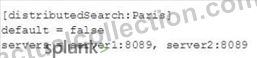
- A. Option D
- B. Option B
- C. Option C
- D. option A
Answer: A
NEW QUESTION # 44
......
Splunk SPLK-1003: Splunk Enterprise Certified Admin is a certification exam that is designed for individuals who wish to prove their expertise in the use and administration of Splunk Enterprise. SPLK-1003 exam is one of the most widely recognized certifications in the IT industry and is highly valued by employers.
Splunk Enterprise Certified Admin Certification Sample Questions and Practice Exam: https://exams4sure.actualcollection.com/SPLK-1003-exam-questions.html